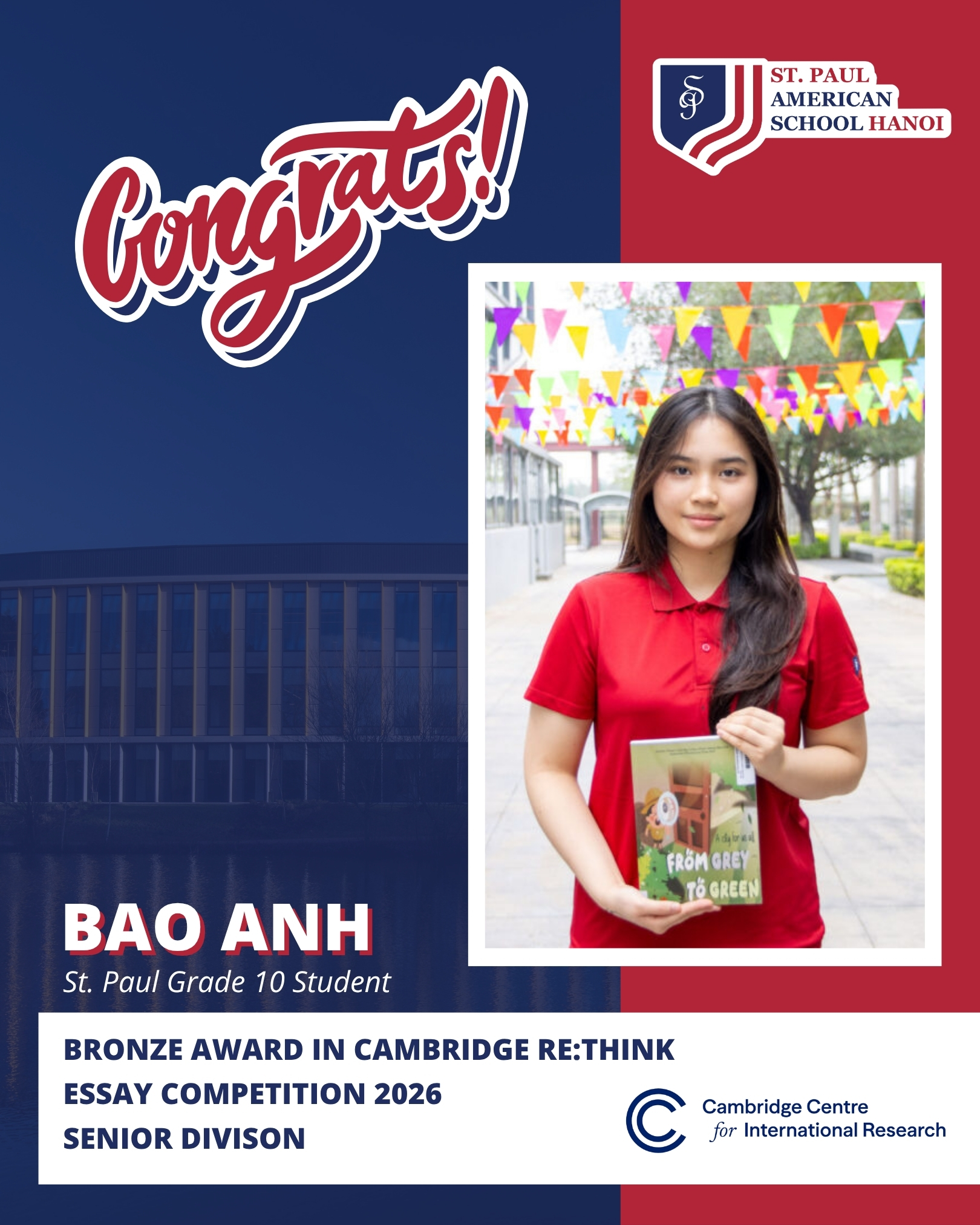
Celebrating Sue Phan: Bronze Winner in the 2026 Cambridge Re:think Essay Competition

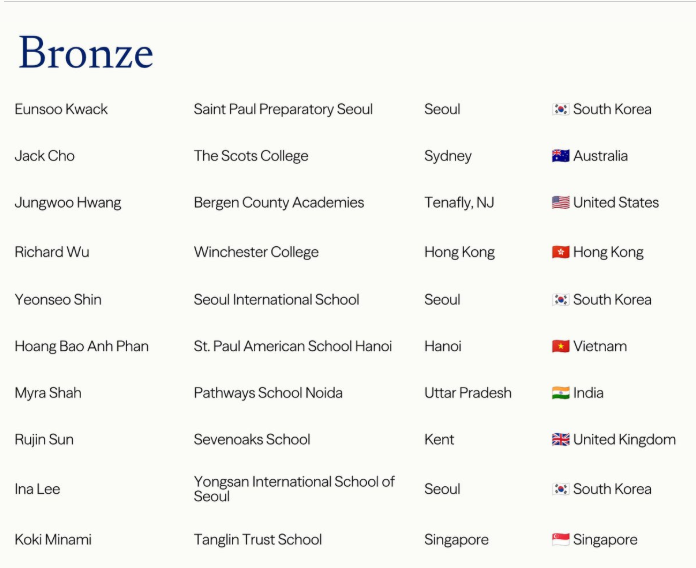
Organised by the Cambridge Centre for International Research, the competition received over 15,000 global submissions from more than 50 countries. Following four rounds of blind academic review by scholars from elite universities—including Cambridge, Oxford, Harvard, and Stanford—only 33 students worldwide were selected as official award winners.

Sue’s essay responded to a complex political prompt by a Harvard professor regarding global governance and the nation-state. Her research required analyzing political theory, climate change, migration, and international cooperation.

In this interview, we speaks with Sue about her research process, the vital role of St. Paul teachers, and how this milestone connects to her wider advocacy work in sustainability and community impact.


Standing Out Among 15,000 Global Entries & Making History for Student Representation in Vietnam

SPASH: Sue, congratulations on this wonderful achievement. For readers who may not know the competition well, w.hat was your first reaction when you found out that you had received a Bronze Award?

Sue: Thank you very much. I was genuinely surprised. I knew the competition was very selective, but I did not fully understand the scale of it until I read the announcement carefully. This year, there were over 15,000 submissions from students in more than 50 countries, and only 33 students across both Junior and Senior Divisions received official awards. Knowing that the essays went through four rounds of blind academic review made the recognition feel even more meaningful. My first reaction was happiness, of course, but also disbelief. After that, I felt deeply grateful, especially because up to now students from Vietnam have not yet represented in this international academic competition.

“I chose that prompt because it felt difficult in the best possible way”

SPASH: Among the nine prompts, why did you choose Professor Mallampali’s question from Harvard about the future of the nation-state?

Sue: I chose that prompt because it felt difficult in the best possible way. It was not a question that allowed me to answer quickly or confidently at first. It asked whether the nation-state should be abolished in favour of new forms of global or regional governance, or whether it remains essential to political identity and stability.

At first, the topic seemed far beyond what I usually study as a high school student. But the more I read, the more I realised that the question was connected to many issues I already cared about: climate change, food security, migration, inequality, and the difficulty of solving problems that do not stop at national borders.

For me, the prompt was not only about political systems. It was about how the world can cooperate when the problems we face are global, while people still need identity, belonging, protection, and accountability from the communities they recognise.

SPASH: Your essay topic connects with global governance, but it also seems related to your environmental and sustainability work. Could you tell us more about that background?

Sue: Yes, definitely. Much of my work before this competition had already centred on sustainability, climate resilience, and community-based solutions. I co-founded VANGUARD Vietnam as a youth-led platform to explore environmental issues in Vietnam through research, advocacy, education, and community support.

Through VANGUARD, I have worked on topics such as seaweed farming, low-carbon agriculture, climate resilience, carbon markets, and sustainable development. These projects helped me understand that environmental problems are never only environmental. They are also about livelihoods, public policy, fairness, technology, and whether institutions can respond in time.

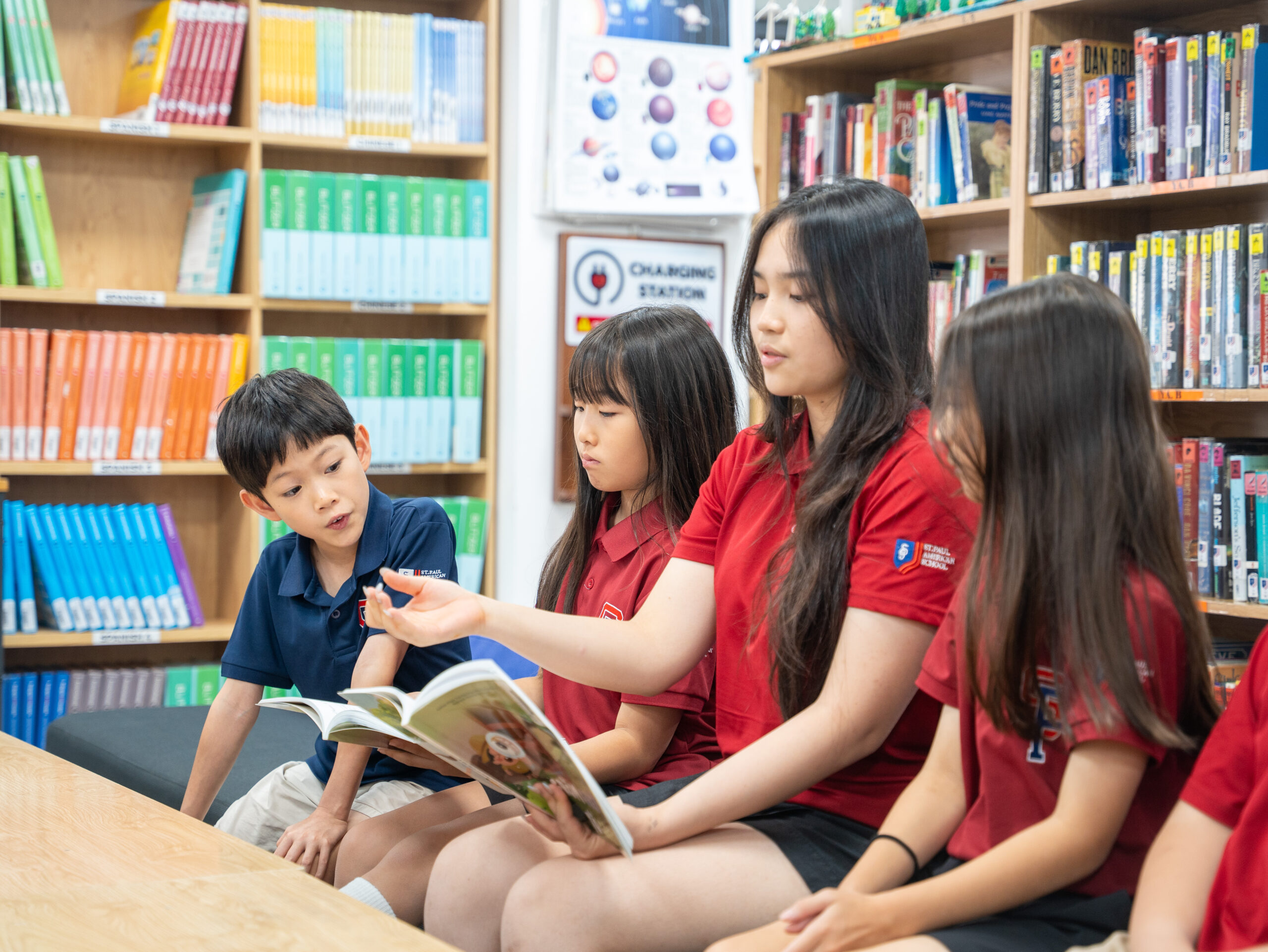
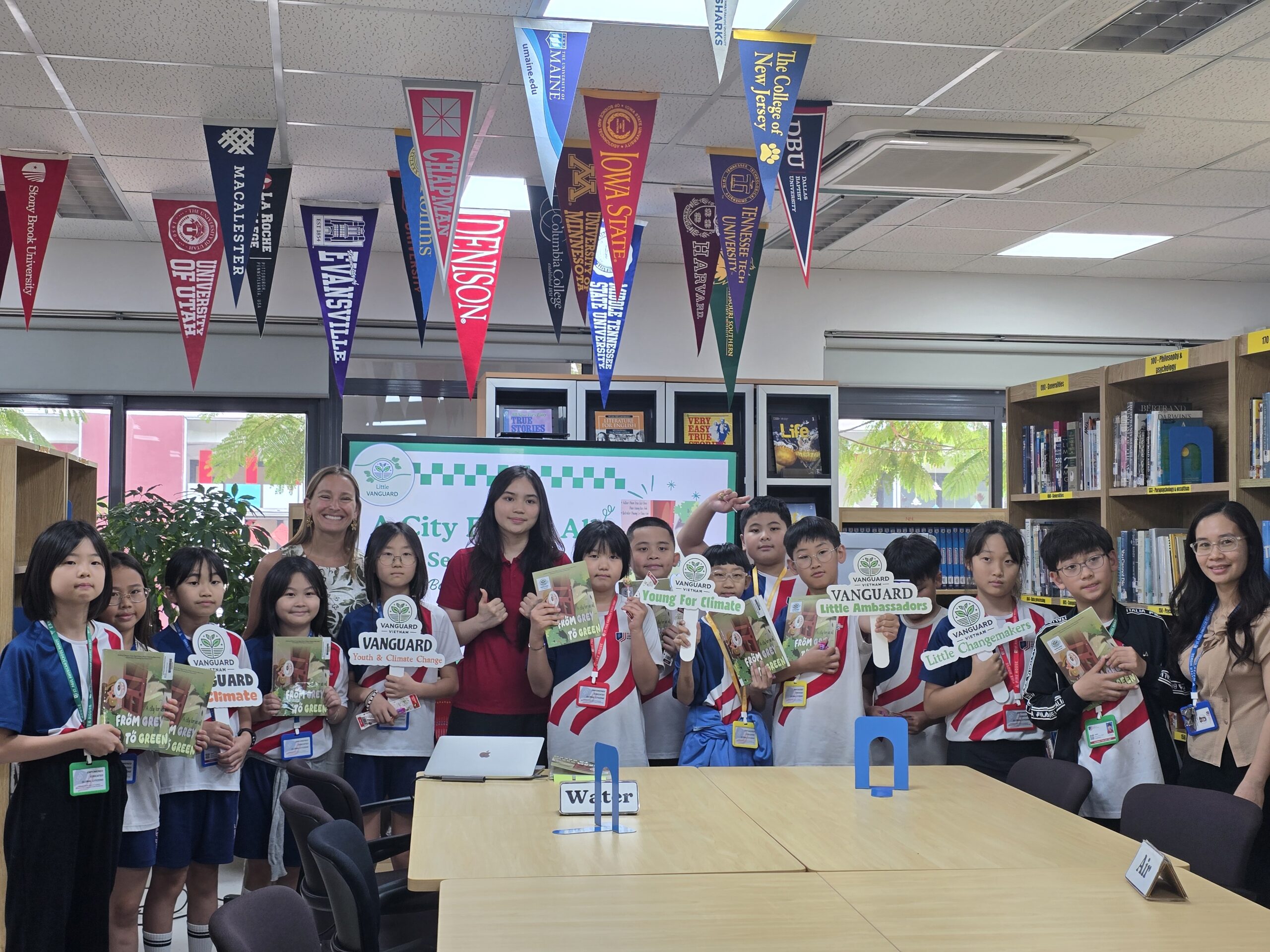
I have also worked on writing projects for younger students. My first book, A City for Us All: From Grey to Green, is an interactive bilingual children’s book on sustainable urban planning and climate awareness. It was written to help younger readers understand ideas such as green cities, sponge cities, urban heat, and environmental responsibility in a more accessible way. I am also planning a second book connected to AI for greener agribusiness, which continues my interest in how technology, agriculture, and sustainability can work together.

In that sense, the Re:think essay felt like a continuation of the same concern, but at a more theoretical level. It pushed me to ask not only what problems the world faces, but what kinds of systems are capable of responding to them.

Through VANGUARD, I have worked on topics such as seaweed farming, low-carbon agriculture, climate resilience, carbon markets, and sustainable development. These projects helped me understand that environmental problems are never only environmental.

Student Published Book
Bao Anh (Sue)
Grade 10 student

Finding Balance Between National Identity and Global Responsibility

SPASH: What was the central idea you explored?

Sue: I tried to avoid treating the question as a simple choice between abolishing the nation-state or defending it exactly as it is. My essay explored whether that binary itself might be too limited.

I argued that the nation-state still matters because it remains one of the main sources of political identity, legitimacy, and public responsibility. At the same time, it is no longer sufficient on its own to solve problems whose causes and consequences move across borders faster than traditional governments can respond.

So the question became less about removing the nation-state, and more about reimagining how sovereignty could work in a world where cooperation has to be more layered, practical, and accountable.

SPASH: This is a sophisticated topic, especially for a Grade 10 student. What made the prompt difficult?

Sue: The hardest part was that the prompt sat between many disciplines. It was not just politics, and it was not just economics or philosophy. I had to think about history, international relations, climate change, migration, institutional trust, and political identity at the same time.

Another challenge was learning to be balanced. It would have been easier to write an essay that strongly supported one side. But the more I researched, the more I realised that the issue was more complicated. A world without nation-states might sound ideal to some people, especially when we think about global problems, but political belonging and public accountability cannot simply be replaced by abstract global institutions.

I had to keep asking myself: who has authority, who is responsible, and who do people actually trust when a crisis happens? Those questions made the essay demanding, but also much more interesting.

Preparation, Support, and Lessons for the Future

SPASH: How did you prepare for an essay that would be reviewed by scholars through several rounds of blind academic review?

Sue: I spent around two months working on the essay. I began with the prompt commentary and the recommended reading because I wanted to understand the question properly before forming an argument. After that, I read more widely through online academic resources and to pick at last research books by geopolitics and economic titans such as Joseph Stiglitz, Joseph Nye, Henry Kissinger, Zbigniew Brzezinski, Ray Dalio, Graham Allison, Benedict Anderson, Zygmunt Bauman, David Held, Kai-Fu Lee, Tim Marshall, Chris Miller to read and undertake analyses to support my essays.

The process was not just about collecting sources. I had to learn how to test whether an idea was strong enough, whether my examples actually supported my argument, and whether the structure of the essay made sense. I went through many drafts. Some versions were too broad, some were too technical, and some tried to include too many ideas.

In the end, I wanted the essay to feel serious but still clear. I was not trying to sound like an expert. I was trying to show that I had read carefully, thought honestly, and built an argument that I could stand behind.

SPASH: How did St. Paul help shape the way you approached this competition?

Sue: St. Paul gave me an environment where difficult questions did not feel like something to avoid. I have been very fortunate to learn from teachers who encouraged me to think more carefully, write more clearly, and not be afraid of complexity.

I am especially grateful to Mr La Roi Williams and Mr Gus Marantos for helping me become more disciplined in the way I structure ideas and connect arguments to the real world. I am also thankful to Ms Stacy Perez, whose encouragement helped me attempt work that I might once not have believed I could do.

For this competition, I needed more than good writing. I needed confidence, patience, and the ability to stay with a difficult question even when I did not yet know the answer. I think St. Paul has helped me develop those habits.

SPASH: What does this recognition mean to you personally?

Sue: It means a great deal, but not because I see it as a final achievement. I see it more as encouragement to continue learning.

As a student from Vietnam, it is meaningful to have my work recognised in an international academic space. But I also know that one award does not make someone complete as a thinker or writer. If anything, it reminds me how much more I still have to read, learn, and improve.

What I value most is that the competition pushed me to take a question seriously even when it was difficult. That experience has made me more confident in approaching topics that feel larger than myself.

SPASH: Some people might think questions about global governance are too advanced for high school students. Why do you think young people should engage with them?

Sue: I understand why these questions can seem distant from high school life. But I also think my generation will inherit many of the consequences of decisions being made now. Climate change, food security, migration, technology, and international conflict are not abstract issues. They will shape our future.

Of course, students do not need to pretend to have all the answers. I certainly do not. But engaging with difficult questions teaches us how to think more responsibly. It teaches us to recognise complexity, listen to different perspectives, and avoid easy conclusions.

For me, that is the real value of competitions like Cambridge Re:think. They invite students not only to write, but to think carefully about the kind of world we are entering.

SPASH: How does this experience connect to what you hope to do in the future?

Sue: I hope to continue exploring the relationship between sustainability, policy, and community impact. My work so far has often begun with environmental questions, but I am increasingly interested in the systems that determine whether solutions can actually reach people.

For example, it is not enough to know that climate solutions exist. We also have to ask how they are financed, who benefits, who is left out, and what institutions are needed to make them work fairly. This competition helped me see that the same question applies at the global level.

In the future, I hope to keep developing as someone who can connect research with real-world responsibility, especially in areas related to climate resilience, sustainable development, and governance.

SPASH: What advice would you give to other SPASH students who want to enter similar competitions?

Sue: I would tell them not to wait until they feel completely ready. Sometimes the point of entering a competition is not that you already know enough, but that the process forces you to grow.

I would also suggest choosing a question that genuinely bothers or interests you. If you only choose a topic because it sounds impressive, it becomes harder to stay motivated. But if the question keeps returning to your mind, then the research process becomes much more meaningful.

Finally, I would say that students should use the support around them. Teachers, school resources, and honest feedback matter a lot. I was very lucky to have that support at St. Paul, and I am deeply grateful for it.

SPASH: Finally, what is one lesson you will carry forward from this experience?

Sue: I learned that serious thinking often begins with discomfort. When I first saw the prompt, I did not feel certain. I felt almost overwhelmed by its scale. But staying with that discomfort helped me grow.

The experience taught me that writing is not only about presenting what you already know. It is also a way of discovering what you think, where your assumptions are weak, and how your ideas can become more responsible.

I am very grateful to Cambridge Re:think for this recognition, and to St. Paul for helping me become more willing to ask difficult questions with patience and humility.

I was very lucky to have that support at St. Paul, and I am deeply grateful for it.

Student Published Book
Bao Anh (Sue)
Grade 10 student